
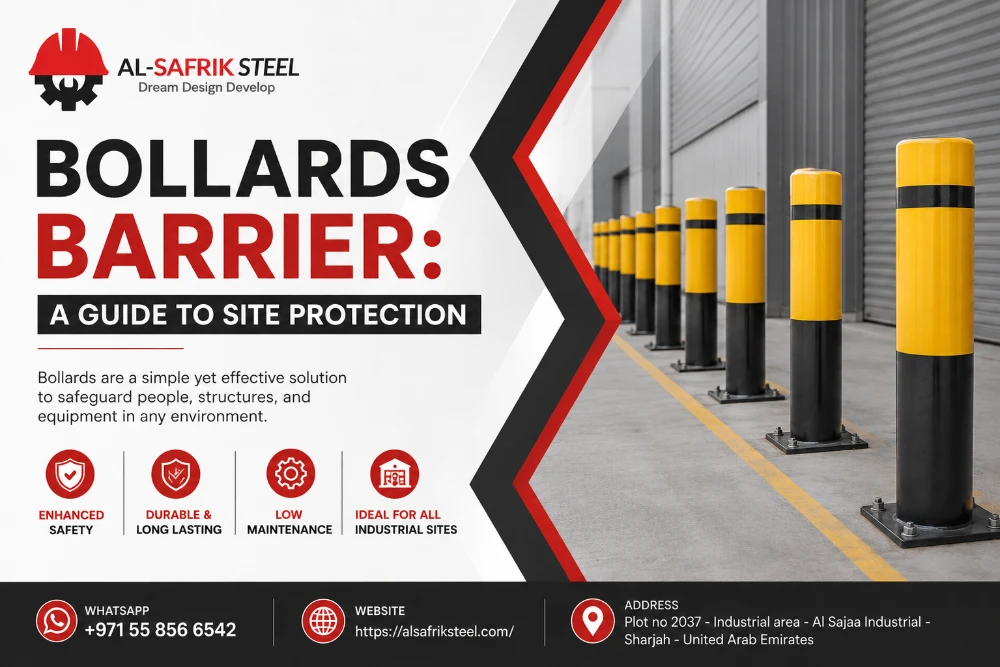
Site protection is a serious operational priority across the UAE. Whether you are managing a commercial development in Dubai, a government facility in Abu Dhabi, an industrial installation in Jebel Ali, or a public space in Sharjah, controlling vehicle movement and protecting people and property from impact threats is a daily responsibility that demands the right physical infrastructure.
Bollards barriers are the primary solution that engineers, security consultants, facility managers, and site developers turn to when that protection is needed. They are not decorative accessories or afterthoughts in site design. In fact, they are engineered safety systems that define access points, stop unauthorized vehicle movement, protect pedestrian zones, and, in critical applications, prevent high-speed vehicle attacks from reaching their intended targets.
What Are Bollards Barriers and How Do They Work?
They are physical obstruction systems installed at ground level to control, restrict, or completely prevent vehicle access to a defined area or along a defined boundary. The term encompasses a broad family of products, from simple fixed steel posts concreted into the ground to sophisticated hydraulic systems that rise and retract on demand, integrated with access control platforms and security management software.
What all bollard barrier systems share is their fundamental purpose: creating a physical line that vehicles cannot cross without authorized permission or without encountering resistance that stops or significantly impedes their movement. In security-focused applications, this resistance is engineered to a certified performance standard. It means the system has been independently tested against a vehicle of specific weight traveling at a specific speed and has demonstrated its ability to stop or deflect that vehicle within a defined distance.
Al Safrik Steel supplies, fabricates, and installs bollards across UAE projects, working alongside security consultants, site engineers, and facility managers to ensure that every installation meets the specific protection requirements of the site it serves.
Types of Bollards Barriers Available in the UAE
Fixed Bollards Barriers:
They are permanently anchored installations that provide constant, unchanging vehicle obstruction. Their presence alone defines the boundary between vehicle zones and protected areas, and they are concreted into deep foundations and do not move.
Permanent bollard barrier systems are the appropriate choice when vehicle exclusion is required at all times. Applications across the UAE include:
- Pedestrian precincts and public walkways in Downtown Dubai and Abu Dhabi Corniche
- Building entrances and lobby approaches where no vehicle access is permitted
- Utility infrastructure protection including transformer enclosures and substation perimeters
- Bridge approaches and critical road infrastructure protection points
- Retail frontages in high-footfall commercial districts
The simplicity of fixed security bollard barriers is also their strength. With no moving parts and no powered components, they require minimal maintenance and deliver consistent protection indefinitely once properly installed.
Removable Bollards Barriers:
They are also referred to as temporary security posts or demountable vehicle barriers. These barriers are installed in ground sockets that allow the bollard body to be lifted out when vehicle access is needed and replaced when it is not. They provide the exclusion performance of a fixed system with the operational flexibility of occasional openings for authorized vehicles.
These systems suit sites where:
- Emergency vehicle access must be maintained across otherwise pedestrianized areas
- Event spaces require vehicle access during setup and breakdown but pedestrian exclusion during public opening hours
- Service lanes need to remain accessible to authorized delivery vehicles on a scheduled basis
- Residential developments require occasional but infrequent vehicle access beyond the normal perimeter
The limitation of removable systems is that they require manual handling and human presence to open and close. This makes them unsuitable for high-traffic or high-security access control points where automated operation is required.
Automatic Rising Bollards Barriers:
Commonly known as hydraulic bollards, electromechanical rising barriers, or retractable security bollards, they are powered systems that rise from a flush ground-level position to full blocking height on demand. They are operated remotely through access control systems, vehicle detection loops, intercom authorization, or integration with broader site security management platforms.
Automatic bollard barrier systems are the preferred solution for managed access control points across the UAE, particularly in high-traffic environments where the flow of authorized vehicles needs to be controlled efficiently without manual intervention at each cycle. They are widely used at:
- Hotel and resort entrance driveways across Dubai, Abu Dhabi, and Ras Al Khaimah
- Shopping mall service access points and basement car park entries
- Corporate campus and office development vehicle access lanes
- Government and diplomatic facility entrance management points
- Hospital and healthcare facility service entrances
The operational cycle speed of rising bollard barriers is an important specification parameter. High-traffic entry points require fast rise-and-fall cycles to prevent vehicle queuing. At the same time, high-security installations may prioritize certified impact-resistance ratings over operational speed.
Crash-Rated Anti-Ram Bollards Barriers:
Also described as anti-ram barriers, hostile vehicle mitigation systems, impact-tested security bollards, or vehicle attack barriers. They are the highest-performance category of bollard barrier system. They are independently tested and certified against recognized international standards, including PAS 68, IWA 14, and ASTM F2656, to demonstrate their ability to stop a vehicle of defined mass traveling at a defined speed.
This certification is what distinguishes genuine anti-vehicle barriers from products that look robust but carry no verified performance guarantee. For critical security applications, certified performance data is not optional, and it is the foundation on which security risk assessments and liability decisions are based.
Crash-rated bollards barriers are required at:
- Critical national infrastructure including power generation facilities, water treatment plants, and communications installations
- Government ministries and federal authority buildings across Abu Dhabi
- Financial institution perimeters and secure data facility boundaries
- High-profile public assembly spaces and event venues
- Military and Defence establishment perimeters
- Airport landside perimeter security points
For projects where security consultants have identified a credible vehicle-borne threat, specifying anti-ram bollard barriers with appropriate certification is a professional and legal obligation.
How To Choose Them?
Selecting the appropriate bollard barrier system for a specific UAE site involves a structured assessment process that considers multiple interconnected factors. Making this assessment correctly before specification and procurement saves significant time, cost, and complication later in the project.
Identify the Primary Protection Requirement:
The first question is always what specific threat the bollards barriers system needs to address. Casual vehicle encroachment, unauthorized parking, managed access control, and deliberate vehicle attack all require different levels of specification. A decorative fixed bollard appropriate for a pedestrian zone boundary is entirely inadequate for a critical infrastructure perimeter.
Determine Access Operational Requirements:
Fixed exclusion, occasional authorized access, high-frequency managed access, and emergency access considerations all point toward different system types. A site with no legitimate vehicle access requirement uses fixed systems. A site with continuous managed vehicle flow uses automatic rising systems. The operational requirement defines the product category before any detailed specification begins.
Assess Ground and Site Conditions:
UAE sites vary considerably in ground conditions, underground service density, surface type, and available installation depth. These physical constraints directly affect which bollard barrier types are feasible. Sites with shallow bedrock or dense underground utilities may require surface-mounted alternatives regardless of preference for traditional systems.
Specify Appropriate Performance Certification:
For any application where vehicle impact protection is a genuine requirement rather than a traffic management function, certified bollard barrier performance data should be specified and verified. This means confirming that the proposed product carries an independent test certificate from a recognized testing body against a relevant standard, not simply a manufacturer’s claim of impact resistance.
Al Safrik Steel provides custom fabrication options for bollard barrier systems across UAE projects, delivering protective infrastructure that meets both the security specification and the aesthetic standards of each development.
Maintenance Requirements for Long-Term Performance
These barriers are long-term infrastructure investments. Their operational reliability and protective performance over time depend directly on the maintenance program applied after installation. A well-maintained system performs as specified for many years. A neglected one becomes unreliable precisely when it is most needed.
Key maintenance requirements across different bollard barrier types include:
- Periodic inspection of foundation integrity and anchor bolt condition for fixed systems
- Mechanical component lubrication and wear inspection for rising and retractable systems
- Hydraulic fluid level monitoring and scheduled replacement for hydraulic systems
- Electronic control system testing, sensor calibration, and software maintenance for integrated access control systems
- Surface treatment inspection and touch-up to maintain corrosion protection in coastal UAE locations
- Post-impact inspection and structural assessment following any vehicle strike event
Establishing a formal maintenance program at the time of installation rather than addressing problems reactively. It is the most cost-effective approach to protecting the performance and lifespan of any site protection barrier system.
Frequently Asked Questions
Do all bollards barriers in the UAE need to be crash-rated?
No, crash ratings are required for high-security and critical infrastructure applications, while standard fixed or decorative barriers suit pedestrian zone management and general traffic control purposes.
Can bollards barriers be installed on sites with underground utilities in Dubai?
Yes, surface-mounted and shallow-foundation bollards barriers are specifically designed for sites where deep excavation is constrained by existing underground infrastructure.
How long do steel bollards barriers last in the UAE climate?
With appropriate corrosion protection and regular maintenance, these barriers last 15 to 25 years in UAE outdoor environments, depending on exposure conditions and finish specification.
Can bollards barriers be customized to match the design of a UAE development?
Yes, custom finishes, stainless steel sleeves, powder-coated colors, decorative profiles, and bespoke fabrication are all available to ensure these barriers integrate with the architectural character of each site.
