
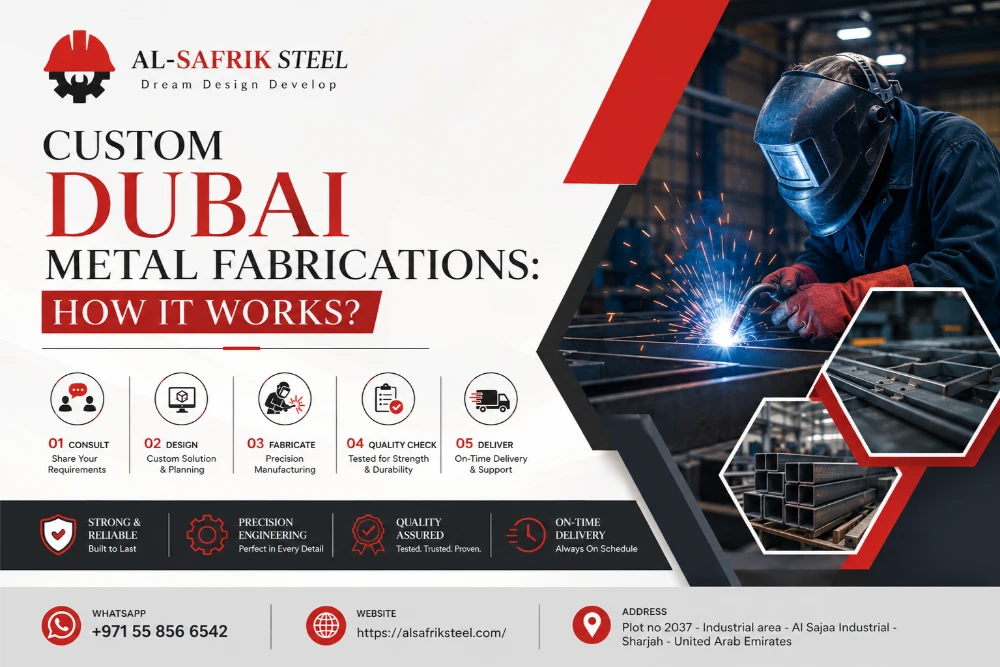
Dubai builds at a pace and scale that few cities in the world can match. From the towering commercial developments reshaping Business Bay to the precision-engineered industrial installations operating across Jebel Ali, every major project in this city depends on one thing that rarely gets enough attention: the quality and accuracy of its metalwork. Custom metal fabrication is the process that turns engineering drawings and design intentions into physical steel, aluminum, and stainless steel components that hold structures together, define architectural expressions, and keep industrial systems running.
For contractors, developers, architects, and project managers working across the UAE, understanding how custom metal fabrication in Dubai actually works helps you make better decisions. From the initial brief through to finished component delivery, communicate more effectively with fabricators, and avoid the costly surprises that come from working with suppliers who treat every project as a production line rather than a custom engineering challenge.
This guide walks through the complete custom Dubai metal fabrication process in practical terms, covering each stage of production and explaining what happens at every step and why it matters.
What Is Custom Metal Fabrication and How Does It Differ From Standard Production?
It is also referred to as bespoke metalwork, precision metal manufacturing, or made-to-order structural metalwork. It is the process of designing, cutting, shaping, welding, and finishing metal components to meet the specific requirements of a particular project or application.
This is fundamentally different from purchasing standard off-the-shelf metal products. A standard steel section from a stockholder is manufactured to a generic specification, useful for many applications, but not designed for any of them specifically. Custom Dubai steel fabrication starts with your project’s unique requirements, including dimensions, load specifications, finish requirements, connection details, and performance expectations. It defines exactly what the component needs to do, and produces something built precisely to meet those requirements.
In the UAE’s construction and industrial markets, where architectural designs are often one-of-a-kind, structural requirements are specific to each building’s engineering, and installation conditions vary widely between projects, custom fabrication is not a luxury option. It is the standard approach for any serious project.
The Precise Process Of Dubai Metal Fabrication
Stage 1 — Project Brief and Design Consultation
Every custom metal fabrication project begins with a detailed brief. Before any metal is ordered or any machine is set up, the fabricator needs to understand exactly what is required. This conversation is where the quality of the entire project is either established or compromised.
A thorough project brief for custom metalwork covers:
- The specific application — structural, architectural, decorative, industrial, or mechanical
- Material requirements — steel grade, aluminum alloy, stainless steel specification, or other metal type
- Dimensional requirements — lengths, widths, thicknesses, and tolerances
- Load and performance requirements — what forces the component must carry or resist
- Surface finish requirements — raw, primed, painted, powder coated, polished, or galvanized
- Connection and installation details — how the component integrates with the broader structure
- Timeline and delivery requirements — when the component is needed and in what condition
At Al Safrik Steel, this consultation stage is treated as a genuine engineering conversation rather than a sales formality. The information gathered here directly shapes every subsequent decision in the fabrication process. The gaps in the brief at this stage create problems that become progressively more expensive to correct as the project advances.
Stage 2 — Engineering, Drawings, and Material Approval
Once the project brief is established, the design and engineering phase begins. For complex custom fabrication projects, this involves the production of detailed fabrication drawings like technical documents that specify every dimension, weld location, connection detail, material specification, and finish requirement for each component to be manufactured.
Dubai metal fabrication drawings serve two critical purposes. First, they provide the fabrication team with precise instructions for manufacturing each component correctly. Second, they provide the client and any third-party inspectors or engineers involved in the project with a document to review and approve before manufacturing begins. Approving fabrication drawings before production begins is one of the most important quality-control steps in the custom metal manufacturing process.
Material procurement runs in parallel with the drawing review process. The fabricator sources the required metal in the specified grade, size, and quantity, verifying that material certifications align with the project specification before any cutting begins. For projects in Dubai’s regulated construction sector, material traceability documentation is often a contractual requirement that starts at this stage.
Stage 3 — Cutting and Profiling
With approved drawings and certified materials in place, physical production begins with cutting. The process of reducing raw metal stock to the sizes and shapes specified in the fabrication drawings.
Modern metal cutting in Dubai fabrication facilities uses several different technologies depending on the material type, thickness, and precision required:
- Laser cutting — Delivers the highest dimensional accuracy for flat-sheet and plate materials, producing clean edges with minimal post-processing required. Particularly suited to stainless steel and precision architectural components
- Plasma cutting — Handles thicker structural steel sections efficiently, with good accuracy and high throughput for production-volume cutting tasks.
- Waterjet cutting — Uses high-pressure water mixed with abrasive to cut without heat, preserving material properties and enabling cutting of heat-sensitive materials or very precise profiles.
- Sawing and shearing — Used for straight cuts on structural sections, tubes, and flat bar where laser or plasma cutting is not required
- CNC profiling — Computer-controlled cutting that follows complex profiles with repeatable accuracy across multiple identical components
The cutting stage is where dimensional accuracy is established. Errors introduced here carry through every subsequent stage, which is why CNC-controlled cutting technology is standard in any serious metal fabrication workshop.
Stage 4 — Forming, Bending, and Shaping
Many custom fabricated metal components require more than flat profiles. Structural brackets, cladding panels, handrail components, ductwork sections, and architectural elements all involve bending, rolling, or pressing flat metal into three-dimensional forms.
The primary forming processes used in Dubai metal fabrication include:
- Press braking — Uses a hydraulic or electric press to fold sheet and plate metal to precise angles, producing box sections, frames, flanges, and panels with accurate bend angles and consistent dimensions
- Roll bending — Curves flat plate or structural sections into circular or compound-curved profiles, used for curved architectural features, pipe segments, and circular structures.
- Tube bending — Forms hollow sections into curved configurations without collapsing the tube wall, essential for handrails, frames, and curved structural members
- Stamping and pressing — Produces repeated identical forms from sheet metal for high-volume component production.
Precision in the forming stage depends on accurate setup of the forming equipment and correct allowance for the material’s spring-back characteristics. The tendency of metal to partially return toward its original shape after forming. Experienced fabricators account for this in their tooling setup, ensuring that finished components meet the specified dimensions without additional correction.
Stage 5 — Welding and Assembly
Welding is the stage that transforms individual cut and formed components into complete assemblies. In custom steel fabrication, weld quality is not just a manufacturing consideration; it is a structural and safety matter. A weld that fails in a structural application can have serious consequences, which is why weld procedure specifications, welder qualification, and weld inspection are formal requirements on most significant projects.
The main welding processes used in Dubai metal fabrication include:
- MIG welding (GMAW) — Widely used for structural and general fabrication, offering good speed and quality across a range of material thicknesses
- TIG welding (GTAW) — Produces the highest quality, cleanest welds with excellent control, preferred for stainless steel, aluminum, and applications where weld appearance is critical
- Stick welding (SMAW) — Robust and versatile, used on site and for heavier structural applications
- Flux-core welding (FCAW) — Suited to outdoor welding and thicker sections where wind and environmental conditions affect shielding gas performance
Following welding, assembled components are inspected for dimensional accuracy, weld quality, and alignment before moving to surface treatment. Any issues identified at this stage are corrected before finishing, preventing defects from being hidden beneath a coating.
Stage 6 — Surface Treatment and Finishing
The surface finish applied to a fabricated metal component serves two distinct purposes: protection and appearance. In Dubai’s demanding climate, corrosion protection is particularly important for any metal components exposed to the outdoors or installed in coastal areas near the Arabian Gulf.
Common surface treatment options for Dubai metal fabrications include:
- Powder coating — Provides durable, attractive color finishes in virtually any RAL or custom color
- Hot-dip galvanizing — Offers robust, long-lasting corrosion protection for structural steel in outdoor or aggressive environments.
- Epoxy and primer painting — Standard industrial protection system for structural and mechanical components
- Polishing and brushing — Applied to stainless steel for architectural and decorative applications.
- Anodizing — Used on aluminum to enhance corrosion resistance and surface hardness
Stage 7 — Quality Inspection and Delivery
Before any component leaves the fabrication facility, it undergoes final inspection against the approved drawings and project specifications. Dimensional checks, weld inspection, surface finish verification, and documentation review are all part of this final quality gate.
Al Safrik Steel, as a steel fabrication company in Dubai, maintains structured quality control processes across every stage of the fabrication process, not just at the end, ensuring that the components delivered to project sites across Dubai, Sharjah, and Abu Dhabi meet specifications without requiring on-site remediation that delays installation and disrupts project programs.
Frequently Asked Questions
How long does custom metal fabrication typically take in Dubai?
Lead times vary with project complexity; simple components may be ready within a few days, while complex structural assemblies typically require 2 to 6 weeks from drawing approval to delivery.
What materials are most commonly used in Dubai metal fabrication projects?
Structural steel, stainless steel grades 304 and 316, and aluminum alloys are the most widely specified materials across Dubai’s construction and industrial sectors.
Can fabricators in Dubai work directly from architect or engineer drawings?
Yes, most experienced Dubai metal fabricators work directly from architectural and structural engineering drawings, converting them into fabrication-ready shop drawings for client approval.
What certifications should a Dubai metal fabrication company hold?
Relevant certifications include ISO 9001 quality management, welder qualification certifications, and material traceability documentation compliant with Dubai Municipality and project-specific requirements.
How do I get an accurate quote for custom metal fabrication in Dubai?
Provide detailed drawings or sketches, material specifications, required quantities, finish requirements, and delivery timeline — the more complete your brief, the more accurate and comparable your quotes will be.
