Material handling is a major part of manufacturing, fabrication, warehousing, construction, maintenance, and industrial operations across the UAE. Moving heavy components by hand can take more time, require more workers, and create unnecessary handling risks. The right lifting equipment can make these tasks more controlled, efficient, and consistent.
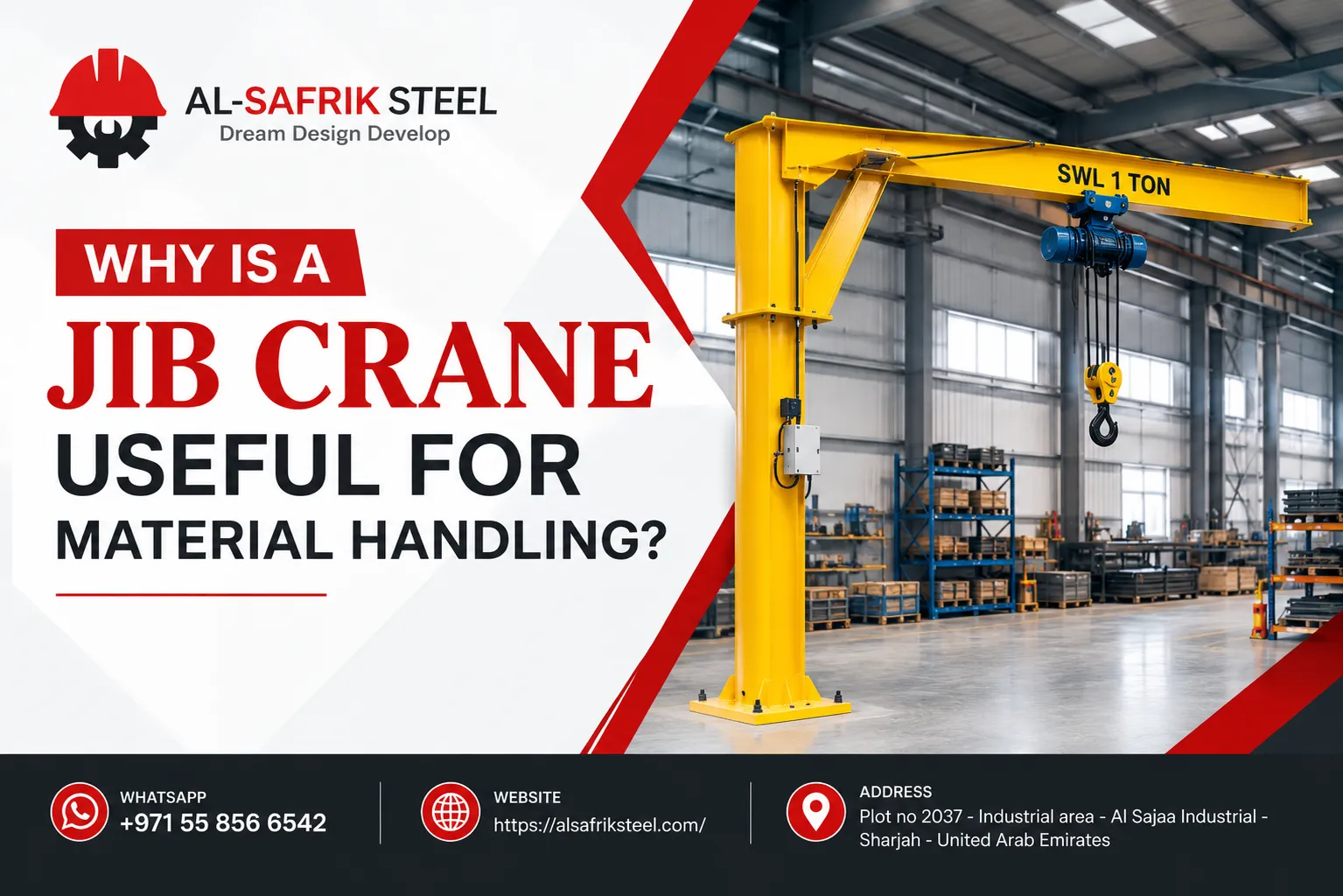
A forklift jib crane is designed for precisely this type of localized lifting. It uses a horizontal arm, or jib, with a hoisting mechanism that raises and moves loads within a defined working area. Depending on the design, the arm can rotate around a fixed point, allowing operators to move materials between workstations, machines, storage areas, and loading points.
For UAE businesses, this compact lifting solution can be particularly useful where floor space is limited or a full overhead crane system isn’t necessary. From workshops in Dubai and Sharjah to industrial facilities in Abu Dhabi and other Emirates, the right lifting arrangement can simplify repeated material-handling tasks.
What Makes a Jib Crane Different?
Unlike a large overhead bridge crane that travels along a runway, a jib crane generally serves a defined workstation or localized lifting zone. Its horizontal boom extends outward from a supporting structure, while a hoist travels along the arm or operates from a fixed position.
This arrangement gives operators a practical way to lift and position loads without requiring a large crane system covering the entire facility. These cranes are available in different configurations, including floor-mounted, pillar-mounted, and wall-mounted designs. Regional suppliers also offer versions with different rotation ranges and specialized configurations for particular applications.
The main components normally include:
- A supporting column, wall bracket, or structural mounting
- A horizontal jib or boom
- A hoist for lifting and lowering
- A trolley where required
- A rotating or slewing mechanism
- Controls and appropriate load-handling accessories
Select the exact configuration based on the load, lifting height, reach, duty cycle, available space, and the installation site’s structural conditions.
How Does a Jib Crane Improve Material Handling?
The primary advantage of a jib crane is its ability to handle repetitive lifting within a specific work area. Instead of using forklifts or relying on manual handling for every movement, workers can use a dedicated lifting point for loads that need to move repeatedly between nearby locations.
For example, a fabrication workshop may need to move steel components from a storage position to a cutting or welding station. A properly designed lifting system can reduce unnecessary manual movement and help operators position the component more accurately.
This localized approach is useful because not every lifting requirement calls for a large overhead system. When the task involves one workstation, machine, maintenance area, or loading point, a smaller crane can provide the required movement without covering the entire building.
Better Use of Limited Floor Space:
Space is an important consideration in modern industrial facilities. Workshops and warehouses often contain machinery, workbenches, storage racks, vehicles, and production equipment. Installing a large lifting system may not always be practical.
A jib crane can provide lifting coverage over a particular area while keeping much of the surrounding floor available for other activities. Wall-mounted models can make use of an existing structural wall or column where suitable. In contrast, pillar-mounted models can be positioned independently when the foundation and structural design allow it.
This makes the equipment useful for:
- Compact manufacturing stations
- Maintenance bays
- Assembly areas
- Machine-loading points
- Workshop benches
- Warehouse handling zones
- Fabrication facilities
The goal is not simply to save space. It is to organize lifting operations around the way materials actually move through the workplace.
Faster Loading and Unloading at Workstations:
Repeated lifting can become a bottleneck when every component must be moved manually or with equipment that is shared across an entire facility. A dedicated jib crane can remain available at a particular workstation, helping operators perform frequent lifting tasks without waiting for another crane or forklift.
Consider a maintenance department that regularly removes motors, pumps, gearboxes, or other machine components. A workstation lifting system provides a controlled way to raise and position these components.
The same principle applies to manufacturing. Operators can lift a component from a pallet, move it across the working radius, and position it near the machine or assembly area. This can help create a smoother workflow and reduce unnecessary transportation within the facility.
Greater Control During Load Positioning:
Lifting a heavy object is only one part of material handling. Positioning it correctly is equally important. Components may need to be placed on machinery, worktables, pallets, fixtures, or assembly points.
A jib crane gives the operator controlled movement within its designed working area. The horizontal arm establishes a defined reach, while the hoist manages vertical movement. Depending on the equipment configuration, the arm may provide a useful rotational range around the mounting point. Some industrial models are designed for 180°, 270°, or 360° movement, depending on their construction and application.
Better positioning can be especially useful when handling:
- Steel plates and fabricated components
- Machinery parts
- Pumps and motors
- Tools and dies
- Manufacturing components
- Maintenance equipment
- Heavy packaged materials
Always operate the equipment within its rated capacity and manufacturer specifications.
Reducing Unnecessary Manual Handling:
Manual lifting can become difficult when materials are heavy, bulky, awkwardly shaped, or frequently moved. A dedicated jib crane can reduce the amount of physical effort required for suitable lifting tasks. This does not mean that every material-handling activity should be mechanized. Workers still need to attach loads correctly, guide operations, inspect equipment, and follow established procedures. Instead, mechanical lifting provides an appropriate solution when loads exceed convenient manual-handling limits.
Safe lifting also depends on selecting the correct sling and attachment. OSHA guidance notes that cranes, hoists, and other lifting equipment commonly use slings to move large, bulky, or heavy loads, and emphasizes proper selection, use, and maintenance.
Suitable for Workshops and Manufacturing Facilities:
A jib crane is commonly used for localized lifting applications because it serves a particular workstation rather than an entire building. This makes the design relevant to workshops, manufacturing lines, assembly areas, maintenance departments, and fabrication operations. In a UAE fabrication facility, for instance, the equipment may be installed close to a welding or assembly station. In an automotive or machinery workshop, it may help move heavy components during maintenance.
The important point is to match the equipment to the actual workflow. A crane intended for occasional light-duty workstation lifting should not automatically be treated as a solution for heavy-duty production requirements.
Different Mounting Options for Different Applications:
One reason businesses consider a jib crane is the range of mounting options available. You can select the supporting structure based on the facility layout and lifting requirements.
- Floor or Pillar Mounted Systems:
A pillar-mounted arrangement uses a dedicated vertical support and foundation. It provides broad coverage around the supporting column and is useful where no suitable wall or structural column exists for mounting.
- Wall Mounted Systems:
A wall-mounted design attaches to an appropriate structural wall or column. It can be useful when the workstation is positioned beside an existing structural support and floor space is limited.
- Special-Purpose Designs:
Certain applications require specialized arrangements, such as low-headroom, two-arm, articulated, or extensible-arm designs. The appropriate configuration depends on the required reach, available headroom, load characteristics, and operating environment.
How to Select the Right Lifting Equipment?
Choosing a jib crane involves more than selecting a lifting capacity. Consider the full operating environment before specifying equipment.
Businesses should review factors such as:
- Maximum working load
- Required lifting height
- Horizontal reach
- Rotation or slewing requirement
- Frequency of operation
- Hoist type
- Available headroom
- Floor or structural conditions
- Indoor or outdoor installation
- Load dimensions
- Environmental conditions
- Required controls and accessories
The supporting structure is particularly important. A crane’s rated capacity does not mean that every wall, floor, column, or foundation can safely support it. Complete an engineering assessment, if needed, before installation.
Safety Should Remain a Priority:
The benefits of a jib crane depend on proper design, installation, inspection, operation, and maintenance. Operators should know the rated capacity and use suitable lifting accessories for the loads being handled. Load ratings are an important part of crane operation. OSHA’s crane standards, for example, define rated loads and require appropriate attention to manufacturer ratings and operating conditions in applicable situations.
A sensible safety program should include:
- Pre-use equipment checks
- Regular inspections
- Correct load attachment
- Properly rated lifting accessories
- Operator training
- Clear working zones
- Avoidance of overloads
- Preventive maintenance
- Following manufacturer instructions
- Prompt reporting of defects
Businesses operating in the UAE should also ensure that their lifting equipment, installation, inspection, and workplace procedures meet applicable UAE requirements and project-specific standards.
Why UAE Businesses Need Practical Material Handling by Al Safrik Steel?
Industrial operations in the UAE often combine high production demands with valuable floor space. We deliver a well-designed lifting system that can help businesses use their available workspace more effectively. The UAE has a broad industrial and commercial base, creating demand for efficient material-handling solutions. A jib crane can support several environments that require localized lifting. Our potential service covers multiple locations and businesses all over the UAE, including:
- Steel fabrication workshops in Dubai
- Manufacturing facilities in Abu Dhabi
- Maintenance workshops in Sharjah
- Industrial operations in Ajman
- Warehousing facilities in Ras Al Khaimah
- Engineering workshops in Umm Al Quwain
- Industrial and logistics facilities in Fujairah
Moreover, our steel fabrication facility also provides countless other tools and products that support multiple businesses, including loading ramps, Skids, and many others.
Final Thoughts:
A jib crane is useful for material handling because it brings mechanical lifting directly to the location where the work takes place. Its compact design, localized coverage, flexible mounting options, and controlled load movement make it suitable for many workshops, manufacturing areas, maintenance stations, and industrial facilities.
For UAE businesses, select the right solution based on actual operating requirements rather than simply choosing the highest-capacity model. Proper engineering, installation, load assessment, inspection, and operator training are equally important for safe and reliable performance.
For organizations seeking industrial steel and material-handling solutions, Al Safrik Steel can serve as a reference point when considering fabrication and related requirements in the UAE.
Frequently Asked Questions:
What is a jib crane used for?
It is mainly used to lift and move loads within a defined workstation or localized operating area.
Where can a jib crane be installed?
Depending on its design, it may be installed on a floor-mounted column, structural wall, or suitable building column.
Is a jib crane suitable for small workshops?
Yes. Its localized lifting coverage can be useful where a full overhead crane system is unnecessary or impractical.
What factors determine crane selection?
Consider load capacity, reach, lifting height, rotation, duty cycle, available space, structural support, and operating environment.
Does a jib crane require maintenance?
Yes. Regular inspection and preventive maintenance help identify wear, defects, and other issues before they affect operation.
