
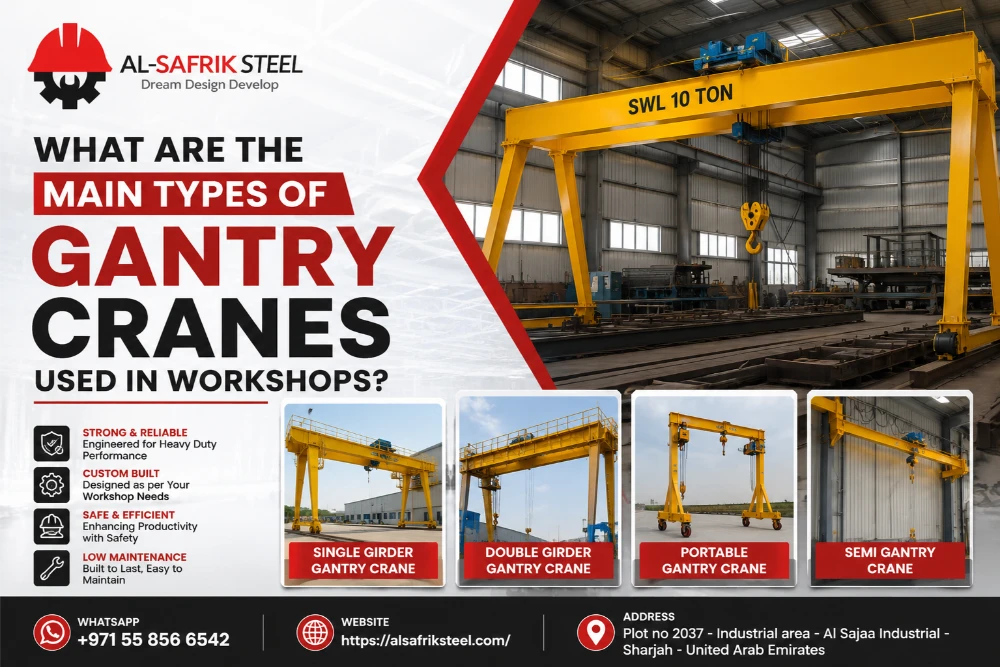
In workshops, fabrication facilities, and industrial plants across Dubai, the ability to move heavy loads safely and efficiently is not a convenience. From the manufacturing corridors of the city to the industrial zones, it is a core operational requirement. Production schedules, worker safety, and equipment longevity all depend on having the right material handling solution in place for the specific demands of the work being done.
Among all the lifting solutions available for workshop environments, gantry cranes occupy a particularly important position. They combine genuine lifting capacity with practical flexibility, enabling them to handle heavy loads within a defined work area without the structural requirements of an overhead bridge crane system. For many workshops, particularly those that operate across open yards, need portable lifting capability, or cannot support the building modifications required for fixed overhead systems, a workshop gantry crane is the most practical and cost-effective answer.
But gantry cranes are not a single product. They come in several distinct configurations, each suited to different load capacities, workspace dimensions, and operational requirements. Understanding the differences between these types is essential before making a selection, and this guide covers each main type in practical detail.
Introduction to How Does It Work?
A gantry crane, also known as a portal crane, shop crane, or overhead gantry system, is a lifting device that uses a horizontal beam supported at both ends by upright legs running along rails or floor tracks. A hoist travels along the beam, allowing loads to be lifted and moved laterally across the structure’s span.
Unlike overhead bridge cranes, which are mounted to the building structure itself, gantry lifting systems are self-supporting. Their legs carry the full load, which means they can be installed in workshops without requiring structural reinforcement of walls or roof columns. This self-contained design also makes certain configurations genuinely portable, an advantage that overhead systems cannot offer.
The core components of any crane gantry system include the bridge beam, the support legs, the end trucks or wheel assemblies, the hoist and trolley mechanism, and the control system. Variations in how these components are configured, what materials they are made from, and how they are designed to move define the different crane types discussed below.
Full Gantry Cranes
Sometimes called a double-leg gantry crane, it features two full-height support legs, one on each side of the beam. Both legs run on rails or floor tracks, and the entire structure moves as a unified unit along the length of the workspace.
This configuration is the most structurally rigid of all gantry crane types, making it the preferred choice for heavy-duty workshop applications where large, consistent loads need to be moved across a defined area. Full gantry crane systems are commonly used in:
- Steel fabrication and structural assembly workshops
- Heavy engineering and manufacturing facilities
- Shipbuilding and offshore equipment workshops
- Precast concrete manufacturing operations
In Dubai’s large industrial facilities, particularly in the petrochemical and heavy manufacturing sectors concentrated around Jubail Industrial City and Ras Al-Khair, full gantry configurations handle loads that lighter alternatives cannot manage safely or reliably.
The main considerations when specifying a full portal crane include the span width between the legs, the required clearance beneath the beam for the intended loads, the available rail length for travel, and the total safe working load. Each of these parameters influences the structural design and material specification of the system.
Semi-Gantry Cranes
It represents a hybrid configuration that combines elements of both overhead bridge cranes and full gantry systems. One leg runs on a floor rail in the standard gantry manner. In contrast, the opposite end of the bridge beam is supported by a runway rail mounted to the workshop wall or column structure at elevation.
The design is particularly well-suited to workshops where floor space is a Premium consideration. Because one side of the crane is supported at height rather than at floor level, there is no leg structure on that side of the workspace, maximizing usable floor area and improving access for vehicles, forklifts, and workers moving through the facility.
Semi-gantry crane systems are commonly specified for:
- Workshops with existing wall-mounted runway infrastructure
- Facilities where aisle clearance is a consistent operational priority
- Mixed-use spaces that serve both lifting and vehicle access needs simultaneously
- Renovation projects where one side of an overhead system already exists
For workshops in Riyadh and Jeddah that operate in existing industrial buildings where full-floor rail installation on both sides is impractical, a semi-gantry configuration often provides the most efficient path to the required lifting capability.
Portable Gantry Cranes
Also described as adjustable gantry cranes, mobile workshop cranes, or rolling gantry frames, they are lighter, freestanding lifting structures designed to be moved between positions within a workshop or transported between sites entirely.
Rather than running on fixed floor rails, portable gantry frames sit on wheeled casters, allowing the entire structure to be rolled manually or with mechanical assistance to wherever the lift is needed. Many portable configurations also offer height adjustability, allowing the beam’s working height to be set appropriately for each task.
Key advantages of portable gantry systems include:
- No floor rail installation required and can be used on any solid, level surface
- Flexibility to serve multiple work areas or outdoor spaces with a single piece of equipment
- Lower initial cost compared to fixed crane installations
- Suitability for smaller workshops, maintenance facilities, and field service operations
Portable shop cranes are widely used in smaller workshops and maintenance operations throughout Dubai, including vehicle repair facilities, equipment servicing yards, and general fabrication shops, where occasional heavy lifting is required. However, a permanent overhead system would be disproportionate to the need.
The load capacity of portable gantry systems is generally lower than that of fixed alternatives, typically ranging from 500 kilograms to around 5 tons, making them appropriate for lighter lifting tasks rather than heavy fabrication work.
Adjustable Height Gantry Cranes
A specific subcategory worth separate consideration is the adjustable-height gantry crane, which has a fixed or semi-portable structure in which the vertical position of the bridge beam can be raised or lowered to accommodate different load sizes and working heights.
Height-adjustable overhead gantry systems are particularly valuable in multi-purpose workshops where the range of work performed varies significantly. A facility that handles both compact component assembly and large structural fabrication on the same floor benefits from the ability to reconfigure the crane height rather than operating a fixed system that suits one task but compromises the other.
Adjustment mechanisms vary between manual pin-and-hole systems in simpler models and hydraulic or motorized systems in more sophisticated configurations. The choice between these options typically reflects the frequency of required height changes and the system’s load capacity.
Truss Gantry Cranes
For applications requiring longer spans, such as wider workshops or open-air work areas where a solid beam would become prohibitively heavy. Truss gantry cranes use a triangulated structural framework in place of the standard solid or box-section bridge beam. This truss design achieves the required rigidity and load-bearing capacity with significantly less material weight than a solid beam of equivalent span.
Truss-style portal cranes are commonly used in:
- Large open workshops and assembly halls
- Outdoor fabrication yards and laydown areas
- Rail and infrastructure maintenance facilities
- Power generation and large equipment assembly operations
In Dubai’s expanding energy and infrastructure sectors, with major projects concentrated in areas including NEOM, the Red Sea Project corridor, and the Eastern Province industrial zones, truss gantry configurations are frequently specified to meet the large-scale lifting requirements these developments generate.
How to Choose the Right Gantry Crane for Your Workshop?
Selecting the most appropriate crane gantry configuration for a specific workshop requires a structured assessment of several interconnected factors:
- Maximum load requirement — The heaviest single lift the crane must handle, with an appropriate safety factor applied
- Span width — The distance between the crane legs or between the floor rail and the wall-mounted runway
- Travel length — The distance the crane needs to cover along the workshop floor
- Available headroom — The clear height between the floor and any obstructions above the intended lift path
- Frequency of use — Duty cycle classification affects structural design and component specifications
- Fixed or portable requirement — Whether the crane serves a fixed location or needs to move between work areas
- Indoor or outdoor operation — Environmental conditions influence material selection and corrosion protection requirements
Getting these parameters defined accurately before specifying a system is essential, and it is where working with an experienced supplier adds genuine value. Al Safrik Steel supports industrial clients across Dubai by specifying, supplying, and structurally integrating gantry crane systems tailored to their workshop requirements. from Jebel Ali Free Zone (JAFZA) to Um Ramool Industrial Area, we provide complete technical documentation and engineering support that major industrial projects demand.
Frequently Asked Questions
What is the difference between a gantry crane and an overhead bridge crane?
A gantry crane is self-supporting with legs that carry the load. In contrast, an overhead bridge crane is mounted to the building structure — making gantry cranes suitable for workshops without structural runway support.
How much weight can a workshop gantry crane typically lift?
Capacities range from under one tonne for portable models to several hundred tonnes for heavy-duty fixed gantry systems used in major industrial facilities.
Can gantry cranes be used outdoors in Dubai’s climate?
Yes, the cranes specified for outdoor use in the Gulf region are built with appropriate corrosion protection and designed to operate safely within the local temperature and wind load conditions.
How long does it take to Install a fixed gantry crane in a workshop?
Installation time varies with system complexity, but most standard fixed gantry crane installations in workshops are completed within several days to a few weeks depending on civil work requirements.
What safety standards apply to gantry cranes used in Dubai?
Gantry cranes in Dubai are typically required to comply with relevant international standards, including FEM, ISO, and the ASME B30 series, as well as any specific requirements from the Saudi Standards, Metrology and Quality Organization (SASO).
