
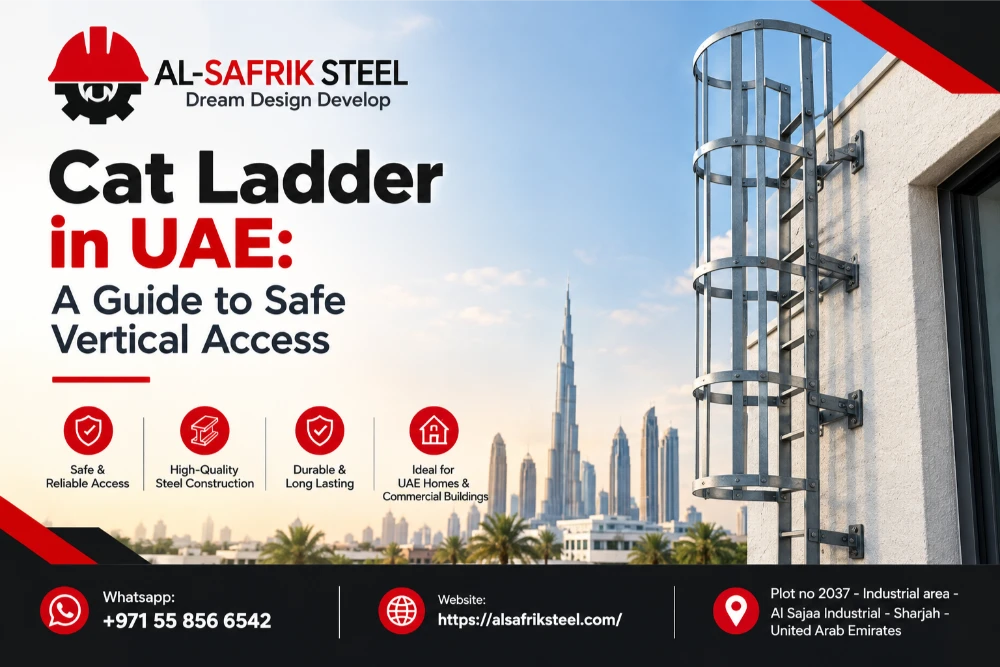
During work hours, employee safety is one of the most important concerns in any industry. Therefore, companies customize tools and equipment to prevent inconvenience. Vertical access is part of daily operations across warehouses, rooftops, water tanks, and industrial plants throughout the Emirates. A cat ladder in UAE facilities is often the safest and most practical way to reach elevated structures that a standard staircase cannot serve. As construction and industrial activity continue to expand across Dubai, Abu Dhabi, Sharjah, and other emirates, facility managers and contractors are paying closer attention to fixed access solutions that meet strict safety expectations.
This guide walks through what a cat ladder is, why it matters, and how to choose the right one for a UAE work site.
Explanation Of A Cat Ladder And Its Functions?
Sometimes called a cage ladder or fixed vertical ladder, it is a permanently mounted ladder attached to a wall, tower, tank, or structural frame. Unlike a portable ladder that gets carried from job to job, this type of ladder stays in place and offers repeated, reliable access to a rooftop, mezzanine, or elevated platform. Many versions include a surrounding safety cage, which wraps around the climber from roughly waist height upward and reduces the risk of a backward fall.
The name comes from the resemblance to how a cat might climb, close to the surface and upright, rather than the angled stance used on a standard ladder. In the UAE, this vertical access ladder has become a standard fixture in industrial yards, logistics parks, and utility installations where recurring rooftop or tank access is required.
Why Vertical Access Matters Across Industries?
The country’s industrial and construction sectors depend heavily on infrastructure that requires regular inspection and maintenance. Rooftops need periodic checks for HVAC units and solar equipment. Storage tanks need access points for level monitoring. Warehouses often include mezzanine floors that staff must reach several times a day. A properly fabricated steel cat ladder in UAE gives workers a fixed, dependable route to these areas instead of relying on ladders that must be repositioned each time, which increases the chance of an accident.
Heat is also a factor unique to this region. Workers climbing in high temperatures need equipment that will not degrade quickly under UV exposure or humidity swings near the coast. It is one reason galvanized steel and other corrosion-resistant materials are favored for outdoor installations in cities such as Dubai, Abu Dhabi, and Sharjah.
Key Safety Features to Look For:
Not every fixed ladder offers the same level of protection. Buyers should evaluate the following features before committing to a supplier.
- Safety cage or hoop guard that surrounds the climber above a set height
- Non-slip rungs that stay secure even when wet or dusty
- Rest platforms on longer runs to reduce fatigue on tall structures
- Handrails at the top landing to support a safe transition off the ladder
- Anchor points rated for the ladder’s full load and mounting surface
A cat ladder in UAE with cage is generally recommended for any structure taller than a single story, since the cage significantly lowers the risk of a fall being unbroken from top to bottom.
Local Safety Standards and Regulations:
Vertical access equipment installation is expected to align with recognized international benchmarks alongside local occupational safety frameworks. In Abu Dhabi, the OSHAD-SF framework sets out expectations around fall protection and PPE that extend to permanently fixed ladders. Dubai Municipality’s Health and Safety Department has published detailed technical guidelines covering ladder selection, pre-use inspection, and mandatory training for anyone working at height.
On the construction and fabrication side, many suppliers reference international standards such as EN131 and BS EN ISO 14122-4, which set out requirements for rung spacing, cage dimensions, and platform placement on fixed access systems. A cage is typically expected once the climb exceeds a certain height, generally in the range used by OSHA guidelines, to prevent an unobstructed fall.
For any cat ladder in UAE project installation, it is worth confirming the following before work begins:
- The ladder design has been reviewed against BS EN ISO 14122-4 or an equivalent recognized standard
- The mounting structure can support the calculated load, including the weight of a climber and any tools carried
- Local emirate-level authorities, such as Dubai Municipality or OSHAD in Abu Dhabi, have no additional site-specific requirements.
- A pre-use inspection and annual audit schedule is documented and kept on file.
Common Types of Cat Ladders Used in Different Facilities:
Not every project calls for the same design. A rooftop access ladder used on a commercial building differs in height and mounting from a tank access ladder installed on a cylindrical storage vessel. Silo and hopper structures often need a curved or angled section near the top to clear the roof line, while warehouse mezzanine access typically uses a straight vertical run with a simple top landing. Facility planners should identify the exact structure type before ordering, since the mounting angle, rung width, and cage dimensions all change depending on the application.
Some sites also require a removable cat ladder section near ground level to restrict unauthorized access, particularly at utility stations or restricted maintenance zones. This is a common request from clients in Sharjah and Ajman operating facilities near public areas.
The Role Of Cat Ladders in Industrial Growth:
The ongoing infrastructure expansion, driven in part by Vision 2030 goals in neighboring Saudi Arabia and complementary growth strategies across the Emirates, has pushed demand for reliable industrial access equipment higher than in previous years.
New logistics parks, manufacturing plants, and utility installations across Dubai, Abu Dhabi, and the northern emirates all require compliant vertical access as a standard part of construction, not an afterthought added later. This shift has made early coordination with a steel fabricator an important step in project planning, not a late-stage purchase.
Materials Used in Cat Ladder in UAE Fabrication:
Material selection is crucial because it directly affects how long a fixed access ladder lasts in the climate. Galvanized steel remains the most common choice because it resists corrosion while staying affordable for large installations. Stainless steel is often specified for coastal sites or facilities near saltwater exposure, such as ports in Fujairah or Ras Al Khaimah, where standard coatings wear down faster. Aluminum offers a lighter option for structures where weight matters, though it is generally paired with reinforced fittings to match the load capacity of steel alternatives.
Powder-coated finishes are also common on ladders installed in visible areas, since they combine corrosion resistance with a cleaner appearance for facilities open to visitors or clients.
Common Applications Across the Emirates:
Fixed vertical ladders are used well beyond heavy industry. Typical applications include:
- Rooftop access for HVAC, solar panel, and antenna maintenance on commercial buildings in Dubai and Abu Dhabi
- Storage tank and silo access at industrial facilities in Sharjah and Ajman
- Warehouse mezzanine and platform access in logistics hubs near Jebel Ali
- Utility tower and pump station access in Fujairah and Umm Al Quwain
- Emergency egress routes in restricted maintenance zones across manufacturing plants
Because the requirements vary from a small rooftop unit access point to a full silo installation, many facilities work with a cat ladder in UAE teams can consult directly for a design suited to the specific structure, rather than adapting a generic off-the-shelf unit.
Choosing the Right Cat Ladder Supplier:
Selecting a supplier is about more than price. Al Safrik Steel is one such fabricator, producing cat ladders with cages and other steel access products for clients across Dubai, Abu Dhabi, Sharjah, Ajman, Fujairah, and Umm Al Quwain. Working with a steel fabrication partner familiar with local site conditions and regulatory expectations makes it easier to get a ladder that fits the structure correctly on the first attempt.
When comparing suppliers, ask about the gauge of steel used, the type of coating applied, whether cages and platforms are included as standard or as an add-on, and what documentation is provided for compliance records.
Cost Factors to Consider:
Pricing for a cat ladder in UAE projects depends on several variables rather than a single fixed rate. Height is the most obvious factor, since a taller run needs more rungs, more cage sections, and additional mounting brackets. Material choice also affects cost, with stainless steel typically priced higher than galvanized steel but offering longer service life in coastal or high-humidity locations.
Custom features such as rest platforms, angled top sections, or lockable access gates add to the overall quote. Facility managers should request a breakdown of these factors when comparing quotes from different fabricators, since a lower headline price sometimes reflects thinner steel gauge or a missing safety cage rather than genuine savings.
Installation and Maintenance Best Practices:
Correct installation is just as important as the ladder’s design. The mounting brackets must sit on a structurally sound surface, and the spacing between rungs should remain consistent along the full run. Once installed, a cat ladder inspection routine should be built into the facility’s regular maintenance schedule.
- Check for loose bolts, corrosion spots, or bent rungs every few months
- Clean debris or dust build-up from rungs and cage bars to preserve grip
- Repaint or reapply protective coating if surface wear becomes visible
- Keep a written inspection log available for regulatory review
- Replace worn or damaged components immediately rather than waiting for the next scheduled check
A ladder that receives regular attention will hold up far longer against the UAE’s heat, humidity, and dust exposure than one left unchecked between major maintenance cycles.
Why Facilities Choose Al Safrik Steel?
Our company has built a reputation for supplying fabricated steel access products, including cat ladders with cages, tailored to the specific dimensions and load requirements of a client’s structure. Rather than offering only standard sizes, the company works with facility teams across the zone to design ladders that match the mounting surface, expected traffic, and local climate conditions. This approach reduces the guesswork often involved in sourcing access equipment for non-standard buildings, tanks, or towers.
Frequently Asked Questions
What height requires a cat ladder in UAE to include a safety cage?
Most international guidelines, including OSHA references, call for a cage once the climb exceeds around six meters, though many facilities install cages at lower heights as an added precaution.
Are cat ladders suitable for outdoor use in the UAE heat?
Yes, provided the materials are chosen correctly. Galvanized or stainless steel handles UV exposure and temperature swings far better than uncoated metal or lower-grade alloys.
How often should a fixed ladder be inspected?
A visual check every few months is standard, alongside a documented annual audit, in line with Dubai Municipality and OSHAD guidance for equipment used for working at height.
Can a cat ladder be custom fabricated for an unusual structure?
Yes, most steel fabricators, including Al Safrik Steel, offer custom designs to match irregular mounting surfaces, non-standard heights, or specific load requirements.
What is the difference between a cat ladder and a standard fixed ladder?
The main difference is the safety cage. A cat ladder typically includes this surrounding guard, while a basic fixed ladder may not, making the cat ladder the safer option for taller or higher-risk climbs.
Final Thoughts:
A well-designed cat ladder in UAE facilities is a small investment that prevents a much larger risk. From rooftop maintenance in Dubai to tank access in Fujairah, fixed vertical ladders with proper cages, platforms, and materials keep workers safe while meeting the standards expected by local authorities. Facilities planning a new installation or replacing aging equipment should work with an experienced fabricator such as Al Safrik Steel to get a ladder built for the specific structure, climate, and regulatory environment across the country.
