
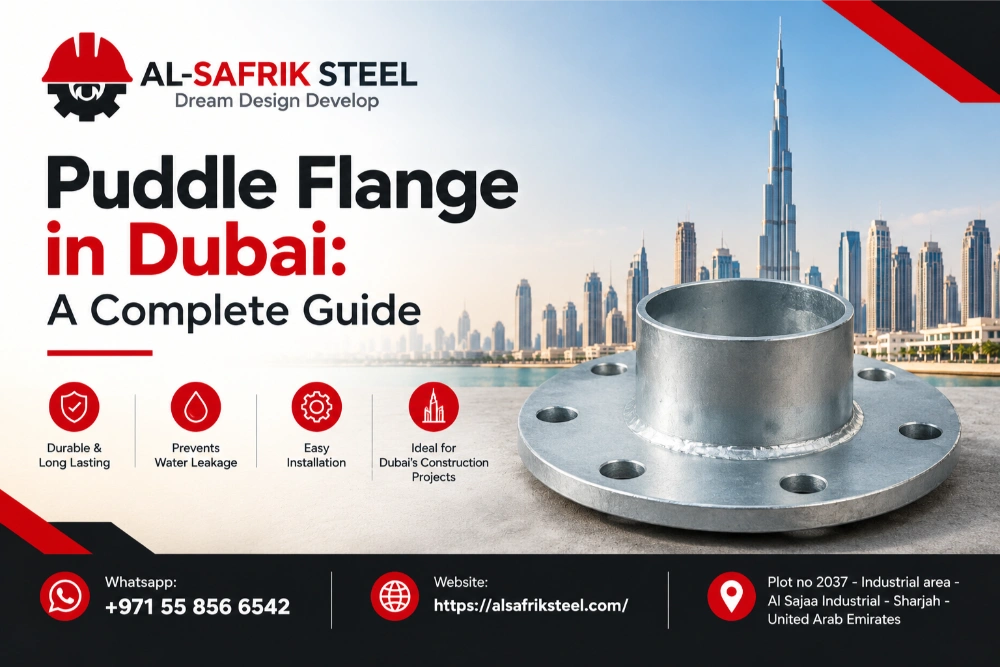
Dubai’s skyline keeps growing, and so does the network of pipes, tanks, and tunnels buried beneath it. Every basement, water tank, and underground utility line depends on one small but critical component to stay dry: the puddle flange. If you are a contractor, MEP consultant, or facility owner sourcing a puddle flange in Dubai, understanding what this fitting does and why it matters can save your project from costly water damage down the line.
What Is a Puddle Flange?
Sometimes called a puddle collar, leak control flange, or seep ring, it is a circular, disc-shaped component fitted around a pipe before it gets embedded into concrete. Unlike a standard pipe flange, which joins two pipe ends together, a puddle flange is not a connection point. Its job is purely defensive: it creates a physical barrier that stops water from creeping along the outer surface of a pipe as it passes through a concrete wall, floor, or slab.
Here is the problem it solves. When concrete is poured around a smooth pipe, the curing and shrinkage process almost always leaves a microscopic gap between the pipe and the surrounding concrete. Water is persistent, and it will find that gap. Once it does, it can travel along the pipe surface and seep into the building envelope, causing corrosion, mold growth, and long-term structural damage. A puddle collar is welded or fixed directly onto the pipe, then cast into the concrete itself, so there is no continuous gap left for water to travel through.
Why Puddle Flanges in Dubai Matter for Construction Purposes?
The environment of the UAE presents a unique combination of challenges that make waterproofing for pipe penetration especially important:
- High-rise basements and podium levels across areas like Downtown Dubai, Business Bay, and Dubai Marina involve multiple underground floors where even a small leak can affect several levels at once.
- Fluctuating groundwater levels in coastal and low-lying zones increase hydrostatic pressure against buried structures.
- Large-scale water tanks and STPs (sewage treatment plants), common in residential towers and industrial facilities in Dubai South and Jebel Ali, rely entirely on pipe penetration seals to hold pressure without leaking.
- Rapid infrastructure expansion tied to Dubai’s long-term development plans means more tunnels, metro extensions, and utility corridors, all of which need reliable concrete pipe penetration solutions.
Given these factors, a steel puddle collar is not an optional extra. It is a core part of any waterproofing strategy for structures built below grade or exposed to standing water.
Types of Puddle Flanges Used in the UAE:
Different projects call for different materials, and the right choice depends on exposure conditions, pipe material, and budget.
- Mild steel (MS) puddle flanges: Economical and strong, commonly used in general construction where corrosion exposure is moderate.
- Stainless steel puddle flanges (304/316 grade): Preferred for corrosive environments such as sewage treatment plants, coastal developments, or facilities handling chemicals, since stainless steel resists rust far better than mild steel.
- uPVC puddle flanges: Lightweight and cost-effective, often used with plastic piping systems in residential or low-pressure applications.
- Rubber puddle flanges: Flexible and useful where slight pipe movement or vibration is expected, though less common for heavy structural applications.
At Al Safrik Steel, fabrication teams work across mild steel and stainless steel seep ring, cutting and welding each unit to match exact pipe diameters and project specifications rather than relying on generic, off-the-shelf sizing.
How a Puddle Flange in Dubai Works?
The mechanics behind a puddle collar are straightforward, but precision during fabrication and installation makes all the difference.
Step No 1: The flange is measured and cut to match the exact outer diameter of the pipe it will surround.
Step No 2: It is welded onto the pipe at the point where the pipe will pass through the concrete structure, forming a continuous, sealed ring.
Step No 3: The pipe, with the flange attached, is positioned within the formwork before the concrete pour.
Step No 4: Concrete is poured around the flange, locking it firmly in place and eliminating any straight-line path for water to travel along the pipe.
Step No 5: Once cured, the flange becomes a permanent, embedded barrier that cannot be removed or retrofitted without breaking out the surrounding concrete.
The last point is worth repeating: seep rings are designed to be cast-in during construction, not added after the fact. Retrofitting a missed penetration is far more expensive and disruptive than planning for it during the design stage.
Where Are Puddle Flanges Commonly Used in Dubai?
They show up in far more places than most people realize. Typical applications include:
- Underground water tanks and reservoirs, where constant hydrostatic pressure demands a fully watertight seal.
- Basement and podium levels of residential and commercial towers in Business Bay, Downtown Dubai, and Dubai Marina.
- Sewage treatment plants (STPs) and wastewater facilities in industrial zones like Jebel Ali and Dubai South.
- Tunnels and underground utility corridors, including sections tied to Dubai’s expanding metro and road infrastructure.
- Swimming pools and water features, common across Dubai’s hospitality and residential developments, where pipe penetrations through pool walls must remain leak-free for years.
- Industrial plants in Al Quoz and JAFZA, where chemical or wastewater handling requires corrosion-resistant flange materials.
Standards and Compliance:
Leak control flange design and installation in serious construction projects typically follow internationally recognized codes, including BS 8007 (design of concrete structures for retaining aqueous liquids) and BS EN 1992-3 (Eurocode 2 for liquid-retaining and containment structures). These standards address how the flange must be sized, positioned, and embedded to withstand hydrostatic pressure over the life of the structure.
It is worth noting that a leak control flange is not a structural support. Its role is strictly waterproofing, and the pipe itself must be independently supported on both sides of the wall or slab to avoid placing shear stress on the flange or the surrounding concrete.
Choosing the Right Supplier For Puddle Flange in Dubai:
Sourcing a puddle collar means working with a fabricator who understands both the technical requirements and the practical realities of UAE construction sites. A few things worth checking before you commit to a supplier:
Custom fabrication capability: Standard sizes rarely fit every project. Look for a supplier who can cut and weld flanges to your exact pipe diameter and thickness.
Material grade options: Confirm the supplier offers both mild steel and stainless steel, since project specifications often dictate the grade based on exposure conditions.
Compliance with recognized codes: Ask whether fabrication follows BS 8007 or equivalent standards relevant to your project’s engineering drawings.
Turnaround time: Construction schedules in Dubai move quickly, and delays in receiving flanges can hold up an entire concrete pour.
Track record on similar projects: A supplier familiar with UAE and Saudi infrastructure projects will understand site conditions better than a generic overseas vendor.
Al Safrik Steel works directly with contractors and MEP teams across the UAE and Saudi Arabia to fabricate puddle flanges, spreader beams, safety barriers, and other structural steel components suited to regional building requirements. Working with a regional fabricator also tends to shorten lead times compared to importing pre-made units from overseas.
Installation Best Practices:
Even a well-made flange will fail if it is installed incorrectly. Site teams should keep the following in mind:
- Position the flange at the exact midpoint of the wall or slab thickness wherever possible, to maximize the embedment length on both sides.
- Ensure the concrete is properly compacted around the flange, since voids or honeycombing near the flange are one of the most common causes of leaks.
- Double-check weld quality between the flange and the pipe before the pour, since even a small gap in the weld defeats the purpose of the flange.
- Coordinate closely with the waterproofing membrane installer, since puddle flanges are often used alongside membranes rather than as a standalone solution.
- Schedule an initial hydro-test after the concrete has gained sufficient early strength, typically around seven days, followed by a final acceptance test once full strength is reached.
Common Mistakes to Avoid:
- Treating the flange as a structural support rather than a waterproofing device.
- Using mismatched materials, such as a mild steel flange on a stainless steel pipe in a corrosive environment, which can lead to galvanic corrosion.
- Skipping compaction checks around the flange during the pour.
- Attempting to retrofit a flange after concrete has already been poured, which usually requires breaking out and reconstructing the penetration.
Top-notch steel fabrication company Al Safrik Steel provides the best customized products for commercial use in different industries. Get a quote first for the best price and exceptional service across the UAE.
Frequently Asked Questions
Can a puddle collar be installed after the concrete has already been poured?
No, they are designed to be cast into concrete during the pour. Adding one afterward typically requires breaking out the surrounding concrete and reconstructing the penetration.
Which material is best for a puddle flange in Dubai’s climate?
Stainless steel is generally recommended for corrosive or high-humidity environments, while mild steel works well for general applications with moderate exposure.
Do puddle collars provide structural support for the pipe?
No, their function is strictly waterproofing. The pipe must be independently supported on both sides of the penetration.
Final Thoughts:
A puddle flange might be a small component on a construction drawing, but its impact on a building’s long-term durability is significant. As Dubai continues to build upward and underground at a rapid pace, getting pipe penetration waterproofing right the first time saves both money and headaches later. Whether you are working on a residential tower in Business Bay or an industrial facility in Jebel Ali, sourcing a properly fabricated, code-compliant puddle flange in Dubai from an experienced regional supplier like Al Safrik Steel is one of the simplest ways to protect a structure for decades to come.
